
Contents
Why Do International Shipments Use Transit Airports?
When people think about air transportation, they often imagine a simple journey from the origin to the destination.
In international logistics, the route is often more complex.
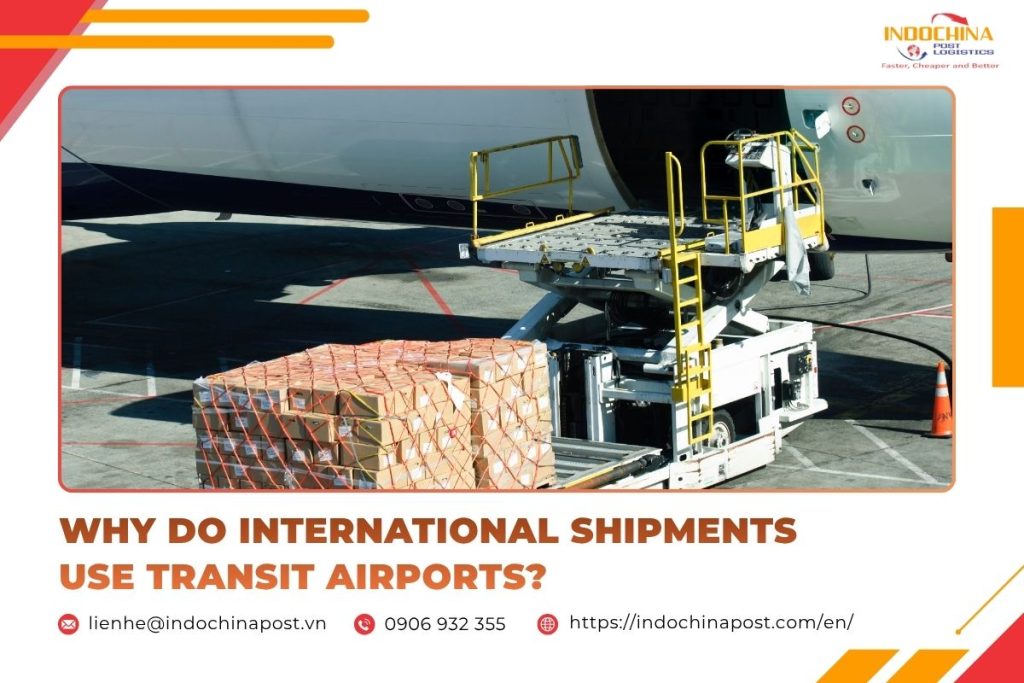
Many shipments travel through one or more transit airports before reaching their final destination. At these airports, cargo may be unloaded, sorted and transferred to another aircraft.
This process is common in Air Cargo.
But why does cargo need to stop at another airport instead of flying directly to its destination?
The answer involves airline networks, flight availability, cargo capacity and geographical coverage.

What Is a Transit Airport?
A transit airport is an airport where cargo stops temporarily before continuing its journey.
The shipment does not normally end its transportation there.
Instead, it is transferred to another flight or transportation service.
A typical route may look like:
Vietnam → Transit Airport → Destination Airport → Final Delivery
For example, cargo from Vietnam may not have a direct flight to a specific destination.
The shipment can therefore travel through a major aviation hub. At the hub, the cargo is transferred to another flight.
This allows airlines and logistics providers to connect destinations that may not have direct services.
Why Don’t All Shipments Use Direct Flights?
Direct flights are not available between every pair of cities.
Airlines operate routes based on demand, aircraft availability and network planning.
Some destinations have frequent direct cargo services.
Others may have limited or no direct connections.
A transit airport helps solve this problem.
Instead of operating a separate flight between every possible origin and destination, airlines can connect multiple locations through major hubs.
This creates a wider transportation network.
For businesses, this means more destinations can be reached even when a direct flight is unavailable.
How Does Cargo Move Through a Transit Airport?
When cargo arrives at a transit airport, it enters another stage of the handling process.
The shipment may be:
- Unloaded from the arriving aircraft.
- Transferred to a cargo handling facility.
- Sorted according to its next destination.
- Checked against transportation information.
- Prepared for the connecting flight.
- Loaded onto another aircraft.
The exact process depends on the airport, airline and type of cargo.
Some shipments may remain within a controlled transit process.
Other shipments may require additional procedures based on the route and applicable regulations.
Good coordination is important at every stage.

Does Transit Make Air Cargo Slower?
Not necessarily.
A transit route includes an additional connection. However, it can still be an efficient transportation solution.
A major aviation hub may have frequent flights to many destinations.
This can provide more options than waiting for a direct flight that operates only a few times per week.
The total transportation time depends on several factors, including:
- Flight schedules.
- Connection time.
- Cargo handling time.
- Available cargo space.
- Airport operations.
- Customs requirements.
- Final delivery arrangements.
Therefore, the number of flights involved does not automatically determine the total delivery time.
A well-planned transit route can sometimes provide a faster solution than waiting for a direct service.
What Happens If Cargo Misses a Connecting Flight?
Missing a connection can affect the shipment schedule.
For example, the first flight may arrive later than expected.
The connecting flight may also have limited cargo capacity.
In some cases, cargo may require additional handling before it can be loaded.
When this happens, the shipment may need to wait for another available flight.
The logistics provider may then coordinate with the airline or handling facility to arrange the next suitable option.
This is why transit planning is important for time-sensitive shipments.
Cargo Capacity Matters
A connecting flight may be available, but that does not always mean there is enough space for every shipment.
Aircraft cargo capacity is limited.
Available capacity can also change from one flight to another.
This is particularly important for large or bulky shipments.
If the available space is insufficient, the cargo may need to be divided between different flights.
For this reason, logistics providers need to consider both flight schedules and cargo capacity when planning an international shipment.
How Is Transit Cargo Tracked?
Shipment visibility becomes more important when cargo passes through several airports.
Tracking information can show important stages of the journey.
For example:
Shipment Received → Departed Origin → Arrived at Transit Airport → Departed Transit Airport → Arrived at Destination → Customs Clearance → Delivered
The level of tracking can vary between carriers and logistics providers.
Some systems provide detailed shipment milestones.
Others only display major transportation events.
Even so, tracking gives businesses a clearer view of their cargo during transportation.
Does Transit Cargo Need Customs Clearance?
This depends on the specific route and local regulations.
Cargo passing through an airport may be handled under a transit procedure instead of being imported into that country.
The customs requirements can therefore differ from those of the final destination.
Factors may include:
- Country of transit.
- Final destination.
- Type of cargo.
- Transportation arrangement.
- Applicable customs procedures.
This is why international cargo routes should be planned with customs requirements in mind.

Which Shipments Can Benefit From Transit Routes?
Transit routes can be useful for many types of international cargo.
They are especially valuable when the destination has limited direct flight connections.
They can also provide access to major aviation hubs.
For businesses, transit routes can create more flexibility when selecting transportation schedules.
For example, a company may need to send goods to a destination where direct flights are not available every day.
A transit route may provide a more practical option.
Transit Airport vs. Destination Airport
These two terms should not be confused.
A transit airport is a temporary connection point.
A destination airport is the final airport in the air transportation route.
However, reaching the destination airport does not always mean the shipment has been delivered.
The cargo may still need to complete customs clearance and local delivery.
Therefore:
Transit Airport = Connection Point
Destination Airport = Final Airport in the Air Transportation Route
Understanding this difference makes shipment tracking easier.
How Can Businesses Reduce Transit Delays?
Businesses cannot control every factor affecting an international shipment.
However, good preparation can reduce unnecessary problems.
Before shipping, businesses should provide accurate:
- Product information.
- Weight.
- Dimensions.
- Shipment quantity.
- Destination.
- Receiver details.
- Required documents.
Special cargo should also be identified before booking.
If a shipment contains batteries, liquids, fragile goods or other regulated products, the logistics provider should know in advance.
Accurate information allows the transportation plan to be prepared more effectively.
Conclusion
Transit airports play an important role in international Air Cargo.
They allow airlines and logistics providers to connect destinations that do not always have direct flights.
During transit, cargo may be unloaded, sorted, transferred and prepared for another aircraft.
The process requires coordination between airlines, cargo terminals, logistics providers and other parties.
For businesses, understanding transit routes can make international shipping easier to plan.
A shipment taking a longer geographical route does not necessarily mean inefficient transportation.
Sometimes, the right transit hub is what makes global cargo transportation possible.
See more
How Does Air Cargo Move From Pickup to Final Delivery?
Why Can’t an Aircraft Carry Every Type of Cargo?
How Does International Logistics Work?
