

Contents
What Is the Bullwhip Effect? How Small Demand Changes Can Disrupt the Entire Supply Chain
In supply chain management, even a slight increase or decrease in customer demand can trigger significant fluctuations throughout the entire supply chain. This phenomenon is known as the Bullwhip Effect.
The Bullwhip Effect is one of the most important concepts in modern supply chain management. If left unmanaged, it can lead to excessive inventory, product shortages, inefficient production planning, and increased operational costs.
Understanding this concept helps businesses build a more resilient and efficient supply chain.

What Is the Bullwhip Effect?
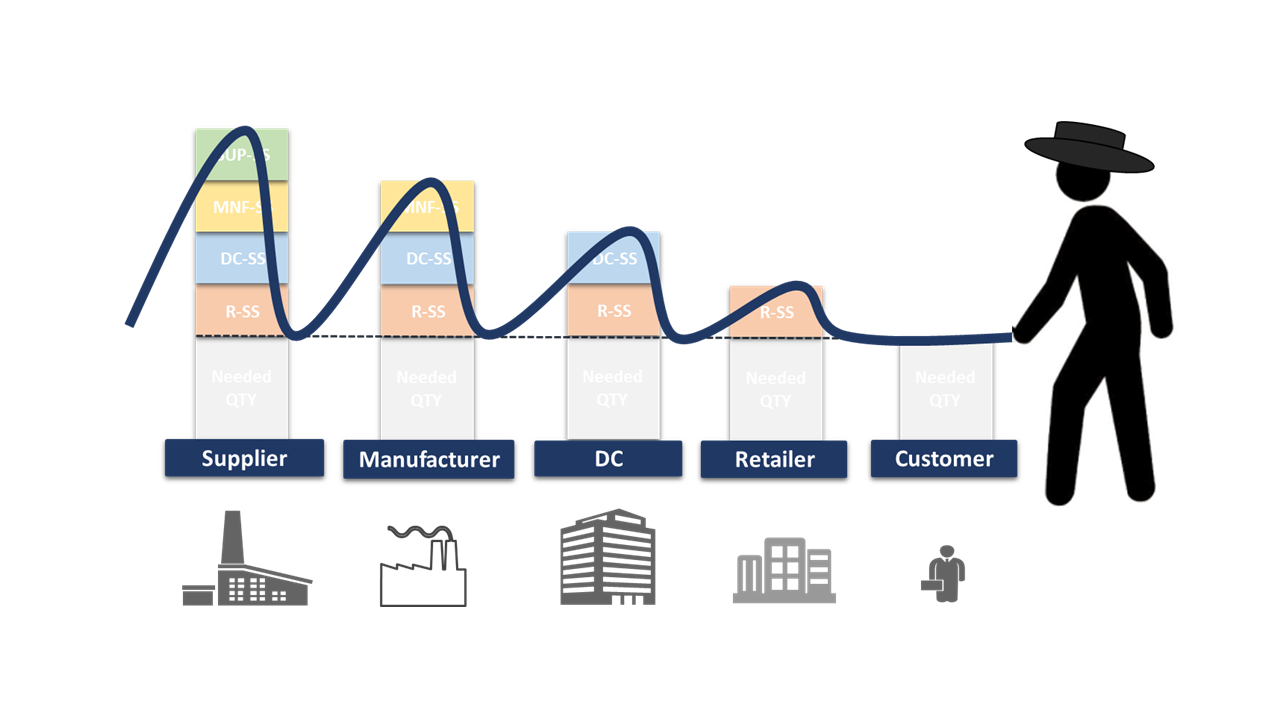
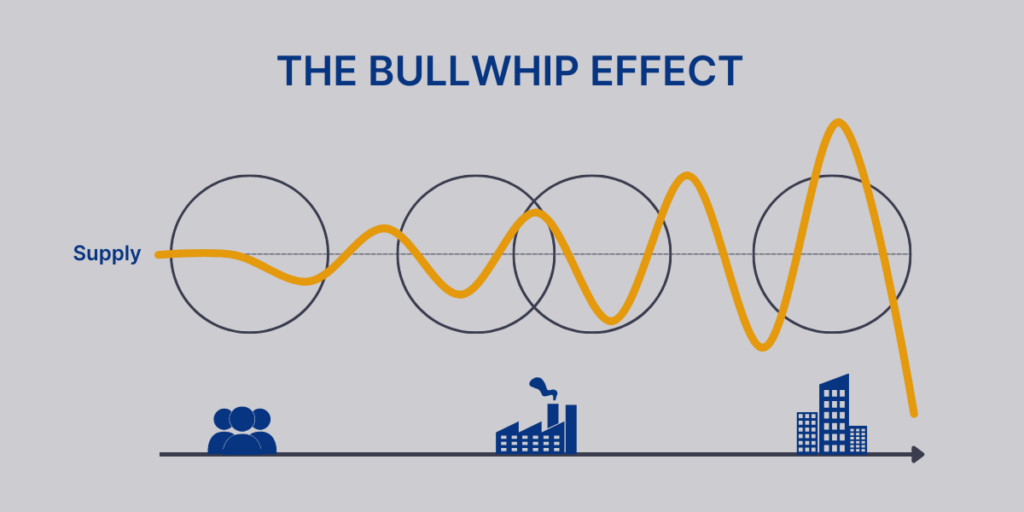
The Bullwhip Effect describes a situation where small variations in consumer demand become increasingly amplified as they move upstream through the supply chain.
The term comes from the motion of a bullwhip.
A small movement of the handle creates increasingly larger waves toward the end of the whip.
Supply chains behave in much the same way.
A minor increase in sales at the retail level may cause distributors to order significantly more products, manufacturers to increase production, and suppliers to purchase additional raw materials far beyond the actual market demand.
A Simple Example
Imagine a supermarket that normally sells 100 cartons of milk per day.
One week, customer demand increases slightly to 110 cartons per day.
Although demand has risen by only 10%, the supermarket orders 130 cartons to avoid potential stock shortages.
The distributor interprets the larger order as a sign of growing market demand and places an order for 160 cartons with the manufacturer.
The manufacturer, expecting continued growth, increases production to 200 cartons and purchases additional raw materials.
As a result, a relatively small change in consumer demand creates a much larger fluctuation throughout the supply chain.
What Causes the Bullwhip Effect?
1. Inaccurate Demand Forecasting
Businesses often forecast future demand based on orders received from customers rather than actual consumer sales.
This can lead to overestimation and unnecessary production increases.
2. Batch Ordering
Many companies place large but infrequent orders to reduce transportation costs or take advantage of supplier discounts.
These irregular purchasing patterns create artificial demand spikes.
3. Limited Information Sharing
When each participant in the supply chain only has access to its own order data, decisions are made without complete market visibility.
This lack of transparency amplifies demand fluctuations.
4. Safety Ordering
During periods of uncertainty, businesses may intentionally order more inventory than they actually need.
While intended to reduce supply risks, this behavior can create artificial shortages and further distort demand throughout the supply chain.
How Does the Bullwhip Effect Impact Businesses?
The Bullwhip Effect affects nearly every aspect of supply chain operations.
Common consequences include:
- Excess inventory.
- Higher warehousing costs.
- Increased transportation expenses.
- Production inefficiencies.
- Product shortages.
- Poor resource utilization.
- Lower customer satisfaction.
Over time, these issues reduce operational efficiency and weaken a company’s competitive advantage.
How Can Businesses Reduce the Bullwhip Effect?
Several strategies can help minimize its impact.
These include:
- Sharing real-time sales data across the supply chain.
- Improving demand forecasting using actual consumer data.
- Placing smaller, more frequent orders.
- Implementing advanced Supply Chain Management (SCM) systems.
- Strengthening collaboration among suppliers, manufacturers, distributors, and retailers.
The goal is to ensure that every participant makes decisions based on the same reliable information.
The Role of Technology
Modern technologies such as Artificial Intelligence (AI), Big Data, and the Internet of Things (IoT) are transforming supply chain management.
These technologies enable businesses to analyze demand patterns in real time, improve forecasting accuracy, optimize inventory levels, and respond more quickly to market changes.
As digital supply chains continue to evolve, companies are becoming better equipped to minimize the Bullwhip Effect.
Conclusion
The Bullwhip Effect demonstrates how minor changes in customer demand can create major disruptions throughout an entire supply chain.
Without accurate information and effective collaboration, these fluctuations can lead to excessive inventory, higher operating costs, and reduced efficiency.
By improving demand visibility, embracing digital technologies, and strengthening cooperation among supply chain partners, businesses can significantly reduce the impact of the Bullwhip Effect and build a more agile, resilient, and cost-effective supply chain.
See more
Shipping Food to Australia: 7 Essential Tips for Fast and Safe Customs Clearance
Shipping Instant Noodles to South Korea: Latest Regulations and Tips for Fast Customs Clearance
