
Contents
WHAT IS CROSS-DOCKING IN LOGISTICS? A HIGH-EFFICIENCY MODEL FOR FASTER SUPPLY CHAIN FLOW
What is cross-docking in logistics?
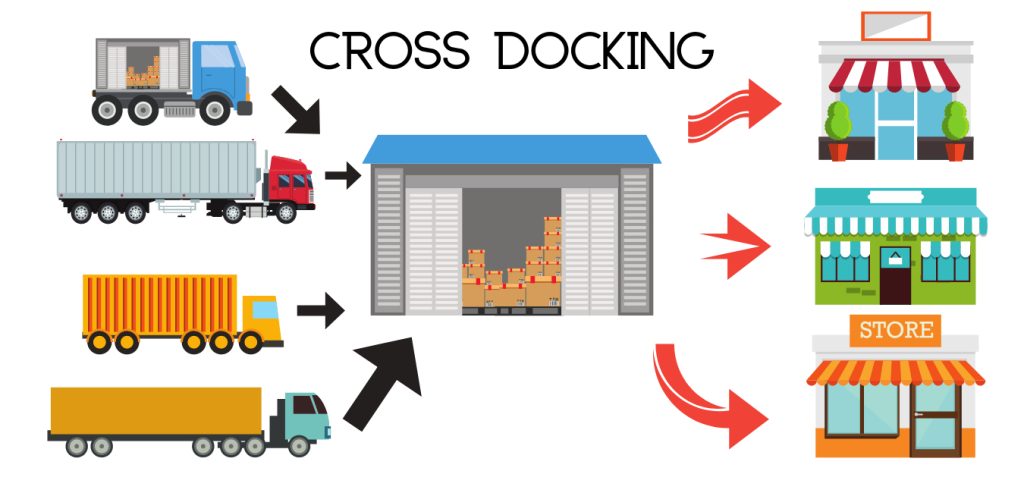
Cross-docking is a logistics distribution model where goods are not stored for long periods in a warehouse.
Instead, products are transferred directly from inbound transportation to outbound vehicles.
The main goal is to minimize storage time and maximize the speed of product flow within the supply chain.
This model is widely used in retail, e-commerce, and fast-moving distribution systems.

How cross-docking works in real operations
Cross-docking operates on a near “no-storage” principle.
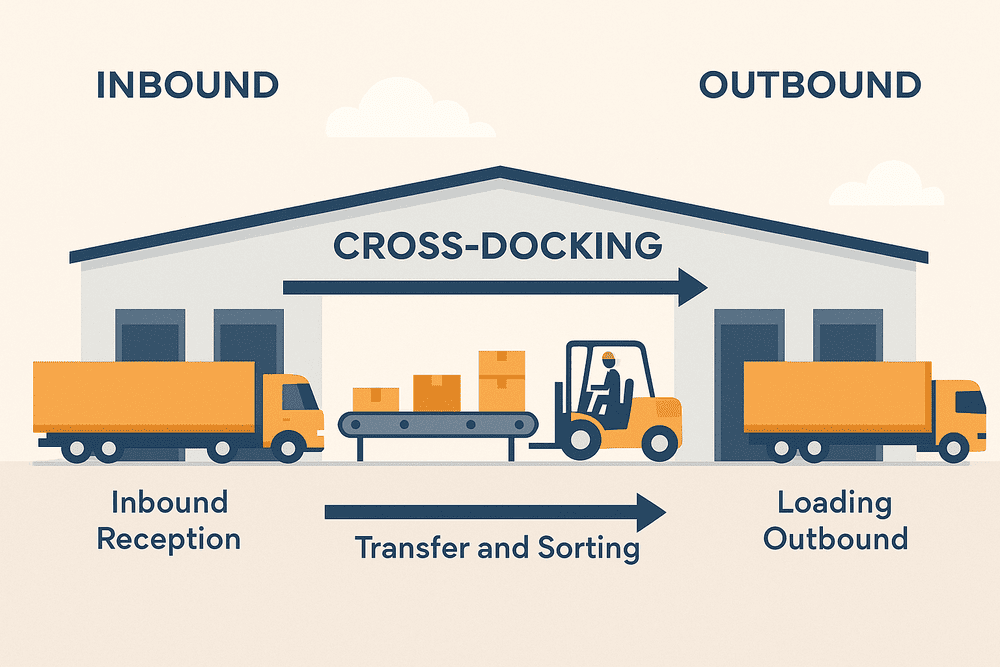
Goods arrive at a distribution center and are immediately sorted based on final destinations.
They are then quickly transferred to outbound trucks without long-term storage.
The entire process may take only a few hours or less than 24 hours.
This reduces warehousing costs and significantly improves delivery speed.
Cross-docking process flow
1. Receiving inbound shipments
Goods arrive at the cross-docking terminal from suppliers or manufacturers.
Each shipment is scanned and verified upon arrival.
2. Sorting and classification
Products are sorted based on delivery routes or customer destinations.
Automation systems and barcode scanning are often used.
3. Consolidation by destination
Orders are grouped according to delivery zones.
This step helps optimize transportation routes.
4. Direct transfer to outbound transport
Goods are moved directly onto outbound trucks or containers.
No long-term storage is involved.
5. Final distribution
Products are delivered to retail stores or end customers.
Comparison: Cross-docking vs traditional warehousing
| Factor | Cross-docking | Traditional Warehousing |
|---|---|---|
| Storage time | Minimal or none | Long-term |
| Warehouse cost | Low | High |
| Delivery speed | Very fast | Moderate |
| Inventory level | Near zero | High |
| Best suited for | Fast-moving goods | Long-term storage |
Key benefits of cross-docking
1. Reduced warehousing costs
Since goods are not stored, storage expenses are significantly reduced.
2. Faster delivery speed
Products move directly from inbound to outbound flow.
This reduces lead time dramatically.
3. Lower inventory risk
Minimal storage reduces the risk of damage, expiry, or obsolescence.
4. Improved supply chain flow
Cross-docking creates a continuous flow of goods across the network.
This improves overall logistics efficiency.
Limitations of cross-docking
Despite its efficiency, cross-docking is not suitable for all supply chains.
It requires highly accurate demand forecasting.
Any disruption in transport schedules can impact the entire system.
It also depends heavily on synchronized data systems.
Products requiring long-term storage are not suitable for this model.
Requirements for successful cross-docking implementation
1. Accurate demand forecasting
Goods must arrive exactly when needed.
2. Strong IT infrastructure
ERP and WMS systems must operate in real-time.
3. Reliable transportation network
Inbound and outbound transport must be well-coordinated.
4. Standardized product handling
Goods must be pre-labeled and ready for sorting.
Impact of cross-docking on supply chain performance
Cross-docking shifts the supply chain from a storage-based model to a flow-based model.
Instead of holding inventory, goods move continuously through the system.
This reduces overall inventory levels and increases responsiveness to market demand.
It also helps companies react faster to changes in customer needs.
Conclusion
Cross-docking is a critical logistics strategy in modern supply chains.
It reduces costs, eliminates unnecessary storage, and improves delivery speed.
However, it requires strong coordination, data accuracy, and transportation reliability.
Companies that implement cross-docking effectively can achieve a significant competitive advantage in fast-moving markets.
